Nicotine strength: how to reason it out
Nicotine strength is the invisible setting that decides whether a first kit stays in use or ends up in a drawer. Set too low and the device never feels settled, so it gets used constantly without satisfying anyone. Set too high and the throat objects from the opening puff. Everything about comfort in the first weeks turns on this one number, and no label explains how to arrive at it. This article sets out the reasoning rather than a figure.
What the figures on a UK bottle mean
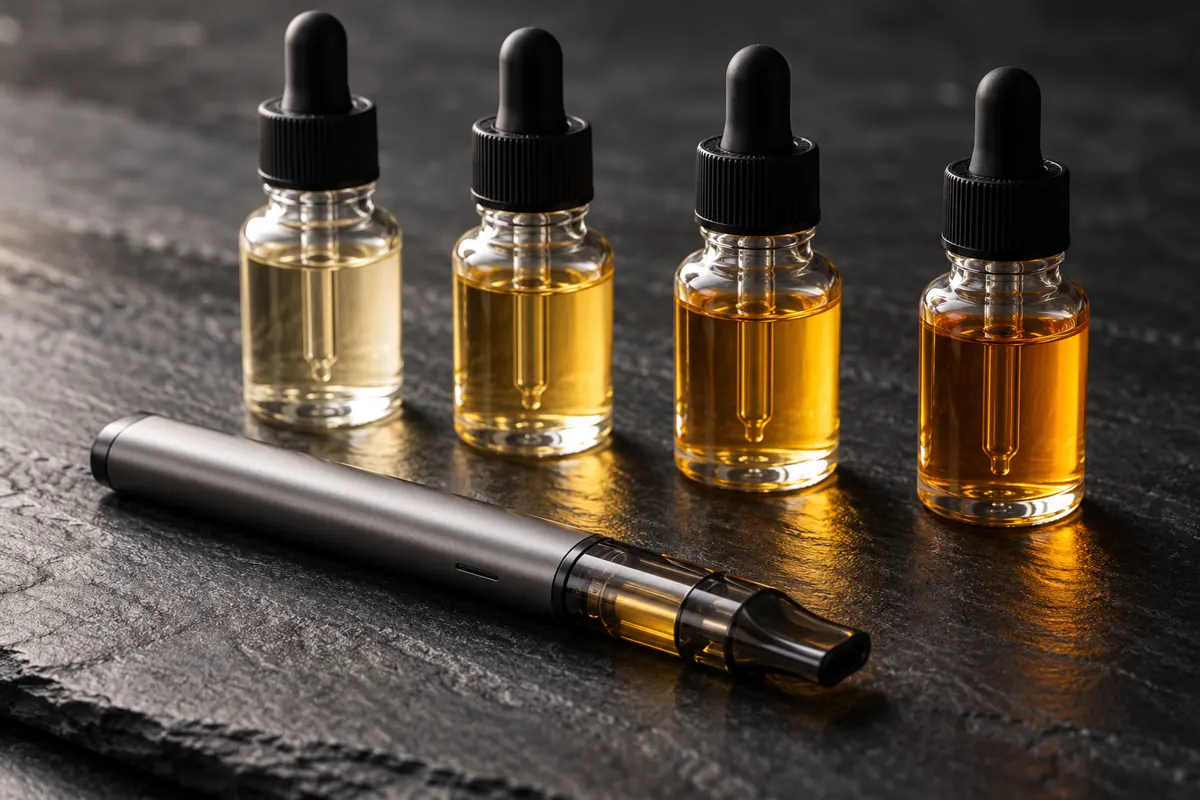
British e-liquid is labelled in milligrams of nicotine per millilitre of liquid, written as mg/ml or shortened to mg on the front of the bottle. The scale on the shelf runs from zero up to a legal ceiling of 20 mg/ml, and nicotine containing bottles are capped at 10 ml.
That ceiling is not a recommendation, it is a maximum. Nothing sold legally here goes beyond it, which is useful to know because articles written for other markets sometimes discuss figures that simply do not exist in a British shop.
The steps between the common figures are not evenly spaced in perception either. Moving from one to the next changes the sensation considerably more than the arithmetic suggests, which is precisely why the choice deserves a method instead of a guess.
Why this article will not hand you a number
Plenty of pages answer the question with a table mapping former tobacco use to a milligram figure. We do not publish one, for a straightforward reason: the same figure lands differently on two people and on two devices, and a number presented as correct invites you to stop paying attention to how you actually feel.
What can be described honestly is the reasoning. A starting point comes from your own history with tobacco rather than from a number picked off a chart. From there, the sensation over the following days does the rest of the work, and the adjustment is made in single steps rather than leaps.
A specialist shop is genuinely useful at this stage, because staff can look at your device and your liquid together. If nicotine use raises any question about your own health, that conversation belongs with a pharmacist or a doctor rather than with an article.
Freebase or nicotine salts: the distinction that changes everything
One difference escapes most newcomers and yet changes the experience completely. Nicotine appears in e-liquid in two forms, and the same figure on the label produces two very different sensations.
Freebase nicotine, sometimes called standard or free nicotine, is the older form. At higher figures it marks the throat firmly, producing the throat hit that some people look for and others find sharp. It sits comfortably at the lower and middle part of the scale on a tight draw kit.
Nicotine salts smooth that edge considerably, so a high figure can be tolerated without the same harshness, and the nicotine arrives faster. This is the form that has come to dominate small British pod kits. The trade off is real: a high salt figure on powerful hardware delivers a great deal per puff, which is exactly why salts and tight draw pods are usually sold together.
Why hardware changes the reading of a nicotine strength
The same bottle behaves differently depending on what it is poured into, and ignoring that is the most common source of confusion. A tight draw pod turns a small volume of vapour into a concentrated sensation, while a powerful direct lung device produces far more vapour per puff.
The practical consequence follows directly. A figure that feels balanced in a small pod becomes a great deal on a wider open device, because you are inhaling much more liquid for the same number of puffs. Anyone changing hardware should expect their nicotine strength to need revisiting, not carry the old bottle across unchanged.
The liquid base plays its part too. Because salts and high figures are formulated for the fluid liquids that feed small coils, the choice interacts with the PG and VG ratio on the label, and the two decisions are best made in the same conversation rather than a fortnight apart. The format question covered in our comparison of a pod or box mod sits upstream of both.
Adjusting a nicotine strength over time
The opening figure is never final. It is a reference point that use refines, and knowing how to correct it is one of the reflexes to acquire early rather than a sign that something went wrong.
Two signals act as a compass. Vaping continuously without ever feeling settled points towards a figure that is too low for you. A throat that stings on every puff, sometimes with a light head, points the other way. Neither signal is subtle once you are watching for it.
Corrections are made one step at a time, with several days between them, because the effect of a change is not obvious within an hour. Changing the liquid, the coil and the figure on the same afternoon guarantees you learn nothing from any of them.
Keeping a short note over the first month makes the pattern visible. Which bottle, which device, and how the days went. It sounds fussy and it saves a great deal of aimless purchasing, as our guide to starting out with a vape explains in more detail.
What the 10 ml bottle changes in practice
British packaging has a quiet effect on all of this. Because nicotine containing liquid is sold in bottles of no more than 10 ml, testing a different figure means buying a small bottle rather than committing to a large one, which makes stepwise adjustment cheap in effort as well as in waste.
Shortfills sit outside that limit precisely because they contain no nicotine at the point of sale, and a separate shot is added by the buyer. That route exists mainly for direct lung hardware and involves working out the final figure yourself, which is a poor place to start while you are still learning what suits you.
For a first few months, small ready mixed bottles keep the arithmetic out of the equation entirely. One bottle, one figure printed on it, and a clear read on how the days go. That is enough information to steer by.
Frequently asked questions
How do I know my figure is too low?
The clearest sign is vaping constantly without ever feeling settled. A continuous, unsatisfied use pattern usually indicates a figure below what suits you. Moving up one step and watching the following few days generally answers the question.
Is too high an unpleasant experience?
Yes. An excessive figure produces a distinct sting in the throat on every puff, sometimes accompanied by a light head. Those sensations are the signal to come back down a step. Moving to salts can also soften a figure that feels harsh in freebase form.
What is the practical difference between freebase and salts?
Freebase marks the throat more firmly at the same figure, with a pronounced hit. Salts feel smoother and arrive faster. On a small pod, salts are what most British kits are built around, which is why the two are usually sold side by side.
Does the device really change how a strength feels?
Considerably. The same figure reads as more intense on a tight draw pod than on a device producing large volumes of vapour, which dilutes the sensation while delivering more liquid overall. Device and figure should be chosen together.
Can I change strength later on?
Of course, and it is expected. The opening figure is a reference point to refine by observation. Adjust in single steps, without hurry, leaving each change several days to show what it actually does before deciding on the next one.
Arriving at a figure instead of guessing at one
Working out a nicotine strength is not a lottery, it is a short chain of reasoning: start from your own history rather than a chart, account for the form of nicotine and for the device it goes into, then read the two signals your body gives back over the following days.
Anyone applying that method settles within a week or two rather than accumulating unsuitable bottles. The right nicotine strength is the one that leaves you comfortable, neither so low that it never satisfies nor so high that it stings, and it is reached by observation rather than by copying somebody else’s number.
Editorial content for adult readers only. Vaping products usually contain nicotine, a substance that causes addiction. Not for sale to under-18s in the United Kingdom. This article is not a buying recommendation.